Tony Peña (1898-1984), significant San Ildefonso Pueblo potter. Photo by Laura Gilpin, 1945, San Ildefonso Pueblo.

3 Likes
The infamous Awa Tsireh, a distinguished Pueblo artist and metalsmith. @chicfarmer has mentioned him in the book thread, but I find his paintings simply beautiful and his metalworking just as accomplished. His taste in belts ain’t bad either…

https://westernartandarchitecture.com/articles/perspective-awa-tsireh-18981955
2 Likes

Thanks for your work on this, Aaron. I’m enjoying revisiting all of the photographs. 
1 Like


So help me out here. This thread is not just historical photos? So photos of Native Americans wearing jewelry belong here not in the fashion thread? I’m a bit confused.
2 Likes
Grab a cup of coffee and take a load off, this post is a bit of a long one.
For anyone passionate about Native American culture, art, and history, few figures stand as important as infamous photographer Edward Curtis.
Known by the Navajo as The Shadow Catcher, his tremendous undertaking that began in 1906, The North American Indian, has become an invaluable resource and fountain of enjoyment since it’s completion in 1930.

@Steve had shared the following wonderful collection of some of The Shadow Catcher’s works earlier in this thread.
Mr. Curtis’ photographs have been discussed here but briefly, and have been caught in the background of photos shared by members here, shying from the camera.
I just recently came across colorized versions of photos he’d taken while documenting a recreated Night Chant that were published in 2017. I’ve enjoyed Curtis’ works for years, but seeing these few in color just takes the experience to a whole new level, for me. All of these were taken between 1904 and 1905, and a few contain some awesome early jewelry.
Rather than sharing the link to the incredibly annoying website these were on, with its bombing advertisements and moving windows, I wanted to share these individually.
These two men are dressed as the Black God (top) and House God (bottom), two of the four deities who presided over the Third World and created the first man and woman, according to the Navajo creation myth.


This image shows the Hero Twins, known in English as Monster Slayer (right) and Born-of-Water (center). According to Navajo belief, they were the children of White Shell Woman, one of the first beings, and roamed the earth slaying monsters that threatened humanity and scalping them. They are accompanied here by a deity named only as The Beggar (left).

A Navajo man stands holding his ceremonial mask (top) and then appears dressed in it (bottom)*. He represents a god known as Fringe Mouth, a water-dwelling deity who participates in the Night Chant. Navajo boys are typically required to undergo a coming-of-age ritual before they are allowed to see which members of their band wear the masks.
- I did note a difference in coloring on the mask in these two particular photos, looks like a simple, honest mistake.


Top is Haschebaad, a representation of several benevolent female deities used specifically for the Night Chant. Bottom is Gaaskidi, deity of harvests, plenty and rain, who is usually depicted with a hump filled with seeds and water that is so heavy he has to lean backwards using a stick to support it.


1 Like
Good question, Zia. Originally, we wanted to make it historical photos only, but decided that might be too restrictive possibly limiting participation.
There has already been lap over between the “Fashion” and “Artwork” threads with these photos, which was the reason a dedicated thread was suggested to help eliminate scatter.
If everyone is good with historical photos only (evident by a significant number of “likes” to this post), I will be happy to change my original post.
1 Like
Got it. I just don’t want to put something in the wrong place and get in trouble 
2 Likes


Jake, a Navajo man, ca. 1907, © Simeon Schwemberger, St. Michaels, AZ.

@Ziacat shared some of Simeon’s other work in post #143 of Turquoise Artwork. Jake looks marvelous with his beautiful four petal squash and Pendleton blanket, but he must not have considered the possibility of belt crazy fanatics enjoying this photo of him 118 years later. 
1 Like
Another wonderful share by @Patina.
Photos of an important Zuni silversmith - Della Casa Appa. My Hougart’s 3rd edition hallmarks book states: “1927, Della Casa-Appa is first woman at Zuni to make silver jewelry”.


1 Like
Parkhurst, Harmon. Patricio Calabasa (Santo Domingo Pueblo). 1925-1930. Palace of the Governors Photo Archives collection.

2 Likes
Frasher, Burton. Chief J. Kevahemah, Hopi Indian, Second Mesa, N.M. 1935 Frasher Foto Postcard Collection.

1 Like
This photograph of two Hopi men is another favorite of mine.
1 Like
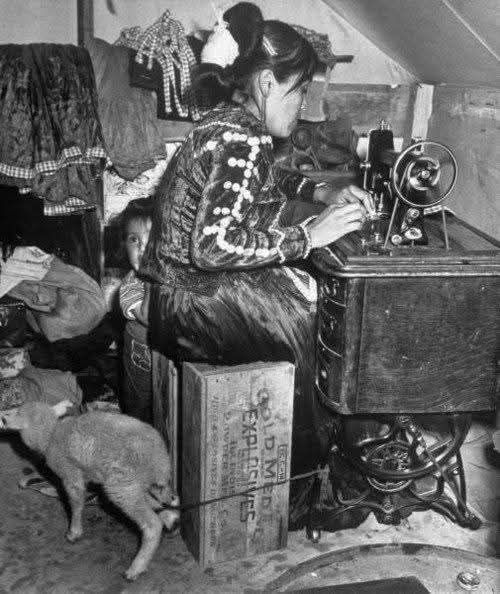
Photos of a Navajo Uranium miner, who looks like he just finished supervising the unloading of a supply truck, as well as a woman and child in the camp: taken by Loomis Dean in 1951. They were published in Life magazine on June 4 of that year.


The photo of Lillie Begay and her son is rather infamous: with her makeshift stool being an empty box of explosives. He looks to be keeping a close eye on the lamb beside her.
I found another photo of the same scene, although, in this shot, the beautiful Pendleton(?) shawl isn’t visible.
2 Likes
^That lamb’s going nowhere! 
3 Likes
