@DianeB Hi & Welcome. I checked my Native American/Southwestern Silver Hallmarks book but, I didn’t come across this hallmark. You may want to try using Google Lens (if you haven’t already). Also, Medicine Man Gallery and https://www.art-amerindien.com are online resources for hallmark identification. Good Luck in your continued research.
1 Like


The hallmark is for Woodard who owned Indian Jewelry Supply and would employ or commission Navajo silversmiths to make pieces. That is why the diversity in the work, it is a shop hallmark.
6 Likes
Thank you very much. I have wondered about it being a shop mark but was never successful at finding the shop. Now I think I’ll try to find a little information about them.
2 Likes
Looking for any information about these stamps and approx age of bracelet. Bracelet is unmarked except for the STERLING stamp.


1 Like
Hello! As you know, your bracelet will be hard to specifically identify without a maker’s mark. I would invite you to take an afternoon at your public library and work with the reference guides, learning about the stamps and patterns, current artists, and basic craft knowledge. Some artists use an identifying stamp along with the pattern, such as a singular circle at the wrist, or a bee hive inserted where flowers are in the rest of the design.
As a guess on age: somewhere between 1970 and today. The Sterling stamp dates after 1930, but the style looks contemporary. Do you have any history about them? They are lovely.

Maybe Sleeping Beauty, maybe Kingman, maybe another mine  Identifying a mine without good provenance is impossible to do with 100% certainty. Google can be a good place to start, but is not always accurate by any stretch.
Welcome to the forum.
1 Like


Can anyone help identify these pieces? They were acquired directly from a Hopi priest in northern Arizona in the late 1950s/early 1960s. The priest was attending a gathering connected to Hopi prophecy in Northern/Central AZ.
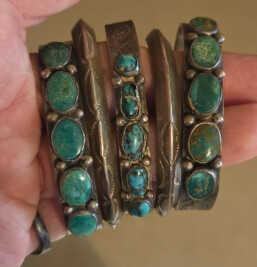
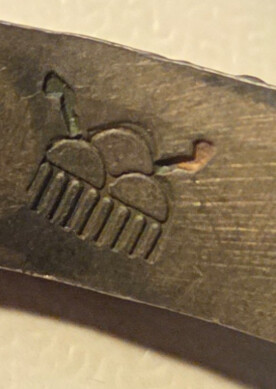
2 Likes
Hi & Welcome. The hallmark shown in the 2nd photo may belong to Ralph Tawangyaouma (Hopi). Are all the cuffs hallmarked? Do they all have the same hallmark as shown in your photo? I think it’s possible the turquoise cuffs could be from the 1950s-1960s time frame.
2 Likes
Hello and thank you for your response.
All 3 bracelets with stones are stamped with the same mark. The 2 silver cuffs are not signed but were part of the set. Is there any way to tell where the stones are from?
2 Likes
Thanks for your reply. Sorry, no. Unless you have provenance, it’s a guess as to the type of turquoise or mine. The only guess I’ll venture is that it looks like American turquoise to me (i.e., not Chinese or Tibetan, etc.).
2 Likes
I’ll second you on American Turquoise. I think it was the 80s when we started getting Chinese Turquoise.
1 Like
I have a family story that goes with the 5 bracelets. Does that help?
In the early 1960s my aunt received those bracelets as a gift from her father. He had gotten them from a Hopi Priest in a remote location just south of Williams, Arizona. The priest had been attending a gathering in the area.
While the exact details have faded, my aunt recalls a story told to her about the profound significance of five stones and five bracelets, which are deeply connected to a creation narrative.
Any help identifying these pieces or suggestions on where to start would be greatly appreciated!
Thank you!!
1 Like
I’m sorry but the photos are not sufficiently good and clear to ascribe it to a known maker. You’d need to show clear detail of each bracelet so that we can see the level of craftsmanship, plus views of the back of the bracelets (i.e. the reverse side), plus images of the hallmark as it positions on that shank. While I agree that the hallmark resembles that of Ralph Tawangyouma, his high level of craftsmanship, particularly in silver working, is not visible as here.
The story behind them sounds cool but, for starters, is second- and third-hand at most. I’m not saying it’s wrong, but it’s not super helpful for understanding what you have. And the quite common design idea of a turquoise row bracelet is not normally associated with a “creation narrative”–unless the maker himself/herself explains that to be their meaning.
In short, better pics would shed better light on quality and origin.
3 Likes
Hello, need help identifying a recent purchase of a Belt buckle. I cannot seem to track down who made this lovely piece, it is 93g. Any information would help, appreciate the help in advance!


I’m of no help concerning the hallmark. A quick search of one resource yielded that it’s an unknown mark. Perhaps others that own a Hougart’s publication will chime in.

However, I can say that with confidence that with the slight curvature of the silver and the four loops soldered in the corners, that what you have is the plaque from a ketoh, or bow guard, and not a buckle. Originally, it would have been mounted to a wide piece of leather via those four mounting loops and worn on the wrist.
Thank you for sharing!
2 Likes
@Ravenscry I’m glad you shared your insight on this. When I looked at the item, I “saw” a ketoh plaque, not a belt buckle. Not an educated guess on my part; however, I don’t discount my gut/intuition when looking at any jewelry or related accessories.
2 Likes
It most certainly was, @Patina. You’re very knowledgeable and well experienced. You’ve no doubt looked at numerous examples and knew how a ketoh could be constructed.
Our inner voices and gut feelings have a propensity for being correct, and yours nailed it. 
2 Likes