In an effort to not perpetuate the act of withholding information, which seems commonplace among many portraying their desire to “…educate and inform those with less experience…” I wanted to share something that, a handful of years ago, took me a while to find.
As an aside, I’d reached out to Sotheby’s about copyright infringement, and never heard back. If I wasn’t concerned with getting sued, I’d scan and share the entire auction catalogue from the famed 1975 auction of C.G. Wallace’s collection, along with the estimates and realized price sheets, to aid interested parties. I guess the best I can do is to openly offer any photos or information from these publications to those who desire it. Simply send me a private message. 
I’m sure that many members here already know this information, and some may even deem it common knowledge, but that’s certainly not the case for everyone. So for any and all that don’t currently possess it, and in the interest of aiding future researchers, the following info is yours for the taking.
In 1998, the Heard Museum in Phoenix, AZ displayed an exhibit titled Blue Gem, White Metal. It showcased pieces from the C.G. Wallace collection that the Museum had acquired. Accompanying the show was an exhibit catalogue by Deborah C. Slaney, and published by the Heard Museum, bearing the same name.

Among beautiful photos and a great many reads, there is some information pertaining to price code system(s) that the Wallace posts employed. These are often (but not always) found on the undersides of some of the jewelry that C.G. Wallace sold, and consist of hand scribed capital letters and numbers.
The Wallace trading posts used at least three different price codes.
-The earliest, PALMNESTRY, stood for 1234567890 and was used from 1928 into the 1940s.
-The second code, FICA=BOLEØ, was used prior to and during Wallace’s partnership with John Kennedy, until 1946. After that date, this code was used only for textile purchases at the Cedar Point Trading Post.
-The third code, KRAFTSZUNI, was used from 1947 until Wallace’s retirement in 1963.
-Wallace also combined letters from each individual code, with the possible addition of 0, H or a reverse F at the end (Wallace pers. com. 1998). Slaney, D. (1998) Blue Gem, White Metal. Heard Museum.
Taking into account the final note and knowing there were other codes, it’s easy to conclude that decoding these markings can require a fair amount of research, and often times they may be impossible to translate.
Here is an example.
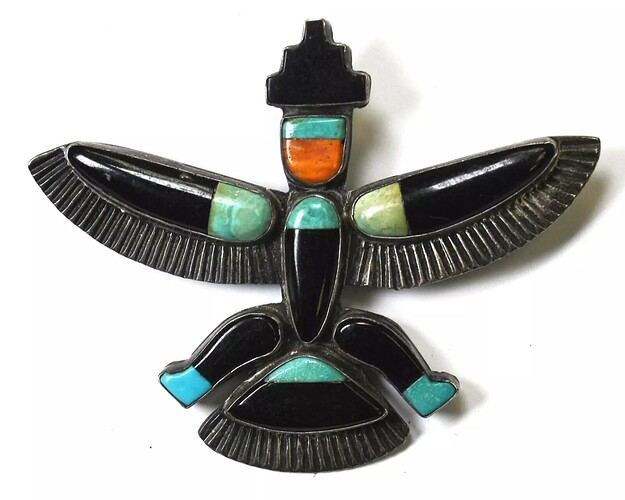

This stunning Knifewing bears “MYY” as well as the “US ZUNI 1” stamp, which was assigned to C.G. Wallace by the Indian Arts and Crafts Board. The IACB stamp definitively dates this beauty between 1938-1943, and the scribed code provides an avenue of further research.
There are many other sources that touch on these codes, including Bille Hougart’s Native American and Southwestern Silver Hallmarks (5th Edition), among others.
I simply wanted to provide a small amount of published information that not all have access to. Being that it was originally shared by the Heard, it’s no doubt a reliable bit to potentially assist a curious mind. 


 I was looking online for info on this last night and found nothing.
