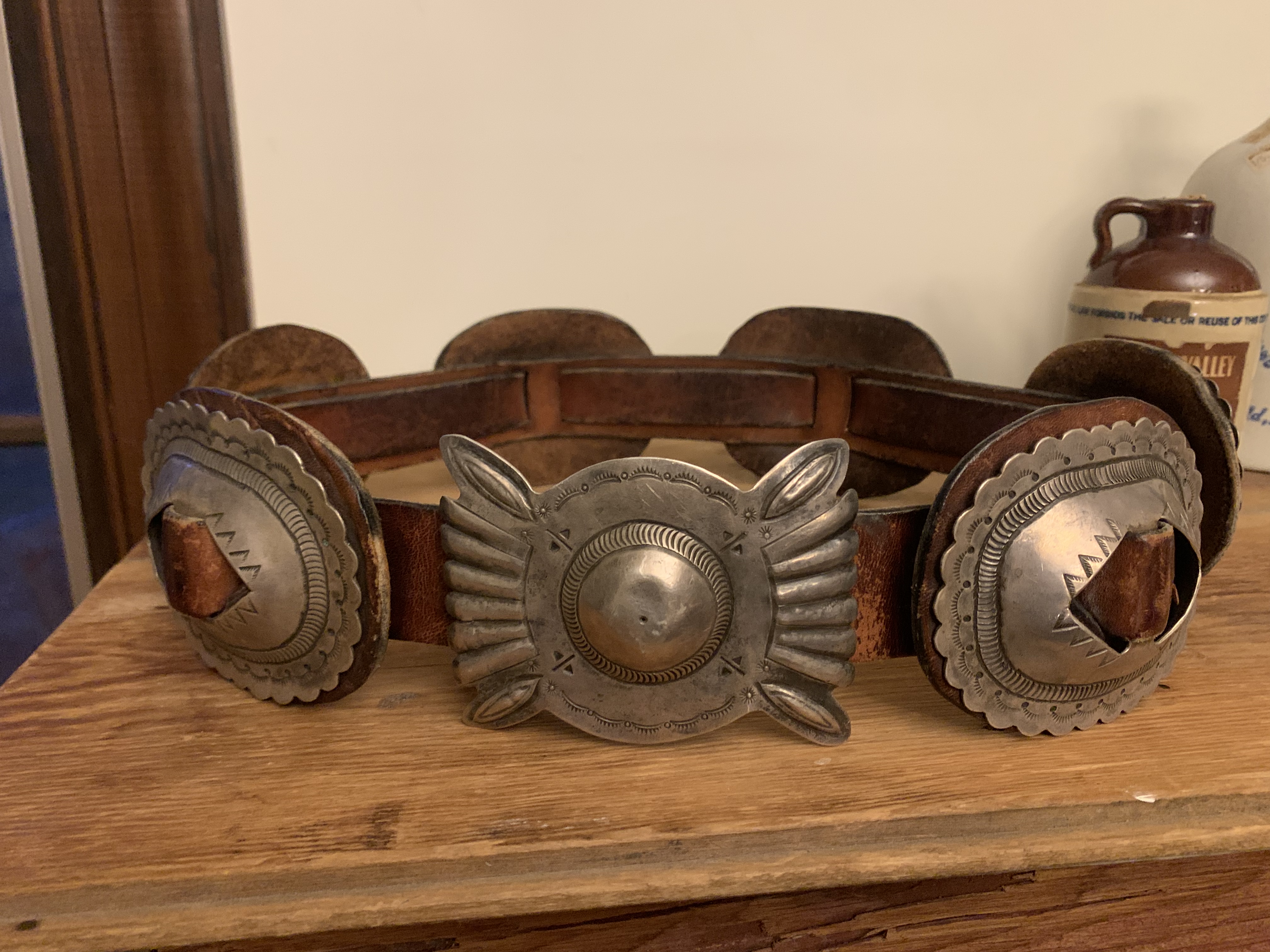
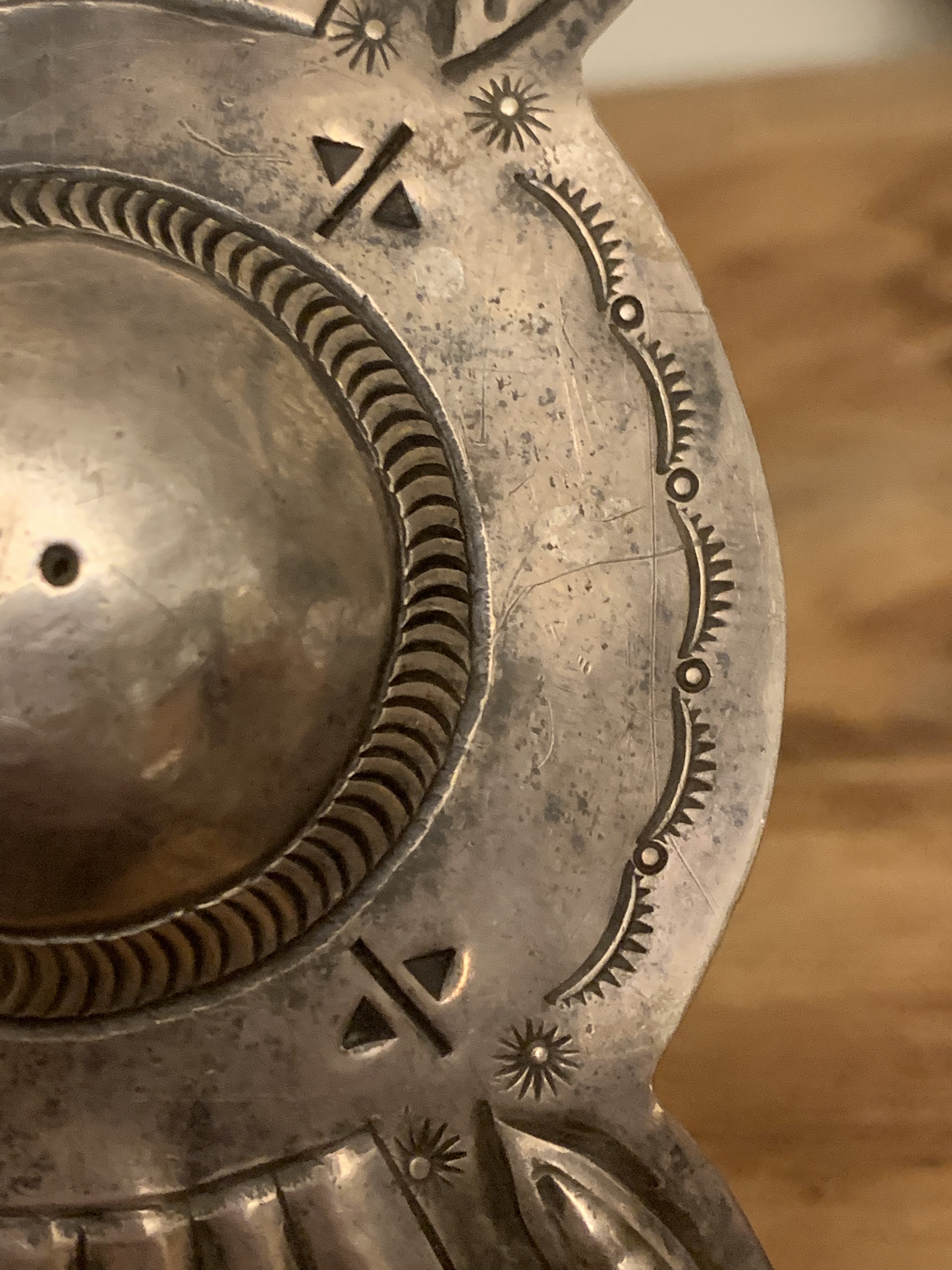
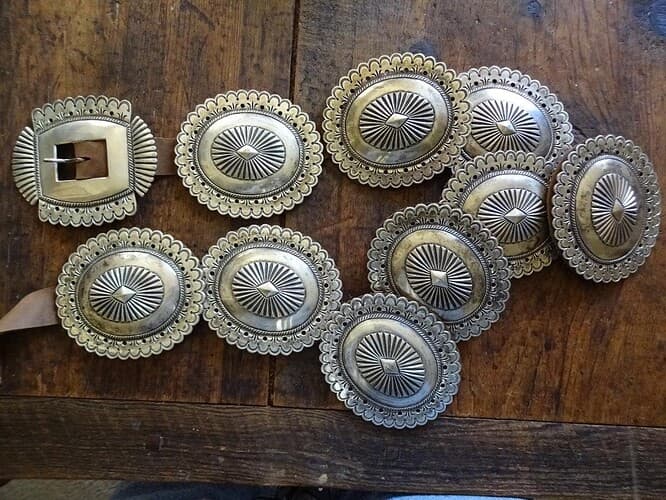
@mmrogers hi Mike! Could you check out my belt? I’d appreciated your opinion if it’s cast? Die struck?
8 Likes
Looks very old, and completely hand made to me. Beautiful belt. Where’d you get it?
6 Likes
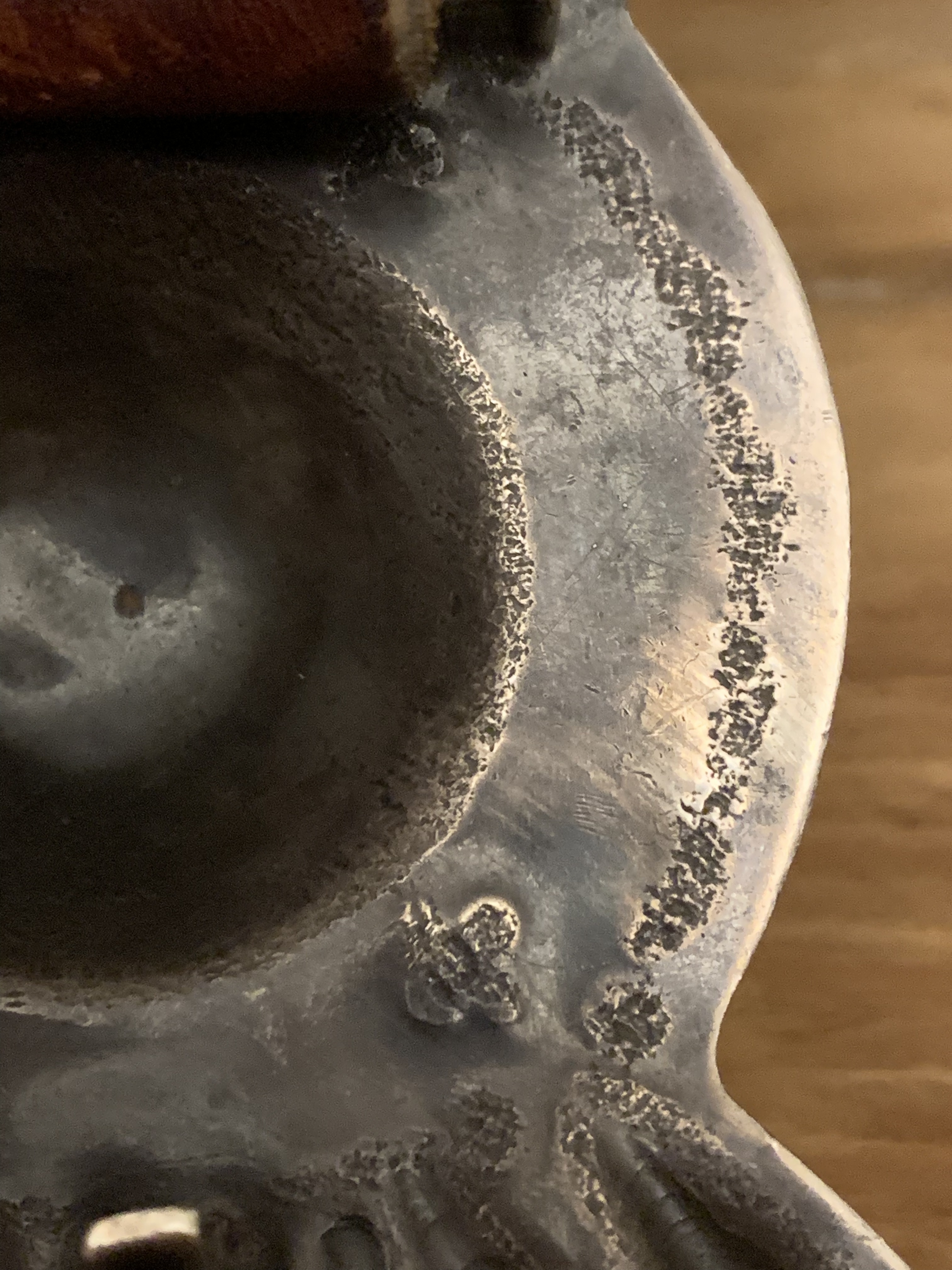
Hi Mike, what would have created the texture on the back of the buckle?
3 Likes
The texture on the back is likely transfer from the rough steel or iron surface upon which the piece was hammered. Normally, you want to hammer or work a piece on the smoothest surface possible because whatever texture is on the surface underneath the piece will be embossed on the back surface when the silver is hammered or worked. For a concha, you need an anvil surface that is as broad, heavy, and stable as possible (usually supported by something large and heavy like a cottonwood stump which absorbs energy instead of bouncing it back up at the piece being worked). In this case it looks like the “anvil” was a piece of heavy cast iron or steel which had little if any smoothing done to the surface.
The porosity and consistency of the surface of the front side of the silver looks like the conchas were fashioned from crude coin silver ingots flattened out with a hammer.
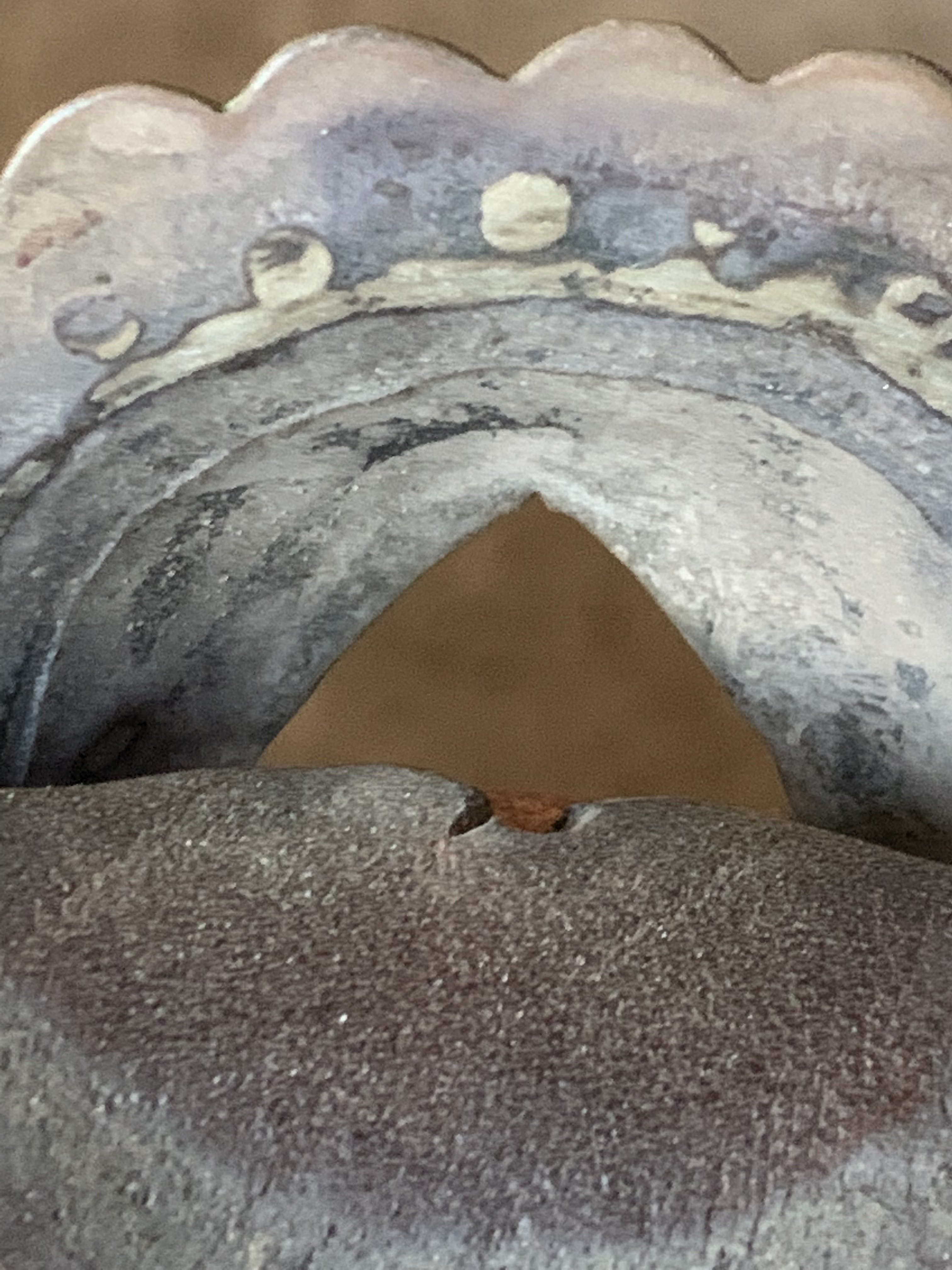
The last photo is kind of interesting because it looks like someone smoothed out the rough areas on the back of the concha by laying it flat on a sheet of fairly fine sandpaper and sanding moving the concha with a back and forth motion, which is exactly how you do it when you are sanding and smoothing a piece like this by hand.
All in all it looks to me like the conchas were fashioned from the most basic tools and materials possible, from a time before store bought milled sheet and smooth factory anvils were commonly available. Could also be a reproduction of this kind of work by a skilled and dedicated enthusiast, but I sincerely doubt it. This looks like the real deal.
10 Likes
I think it’s for sure revival style, which would date it 1940s-1970s. There’s a lot of revival pieces out there, it became a popular idea. It’s just not First Phase, and not Second Phase either. You don’t see that solid domed buckle in early production, among other things.
A silver test would be essential: if it’s sterling, or high-content sterling, that itself dates it.
Obviously a belt with value, and cool and neat!
5 Likes
Looks older than that to me. No reason to make it this way if store bought silver sheet is available. That’s just beating a mule out of job. The work on it, stamps, beveling, chasing work, work surfaces upon which it was made look more primitive than you’d expect to see from a later time period.
On the other hand, anyone reasonably skilled, at any time can make the tools and fashion a belt like this. Taking everything into account though, I don’t think this is a reproduction or homage piece.
3 Likes
@mmrogers Thanks Michael! Always appreciate your thoughts and expertise.
@chicfarmer I understand your line of thinking here. When I first saw this belt, the solid buckle style combined with open-center conchos made me instantly think revival piece. Also, if the leather is original to the silver, the oversized leather backings are unusual for an older piece. On the other hand, it could be old silver on new leather. Due to the stamp work being somewhat rudimentary and simple, I wonder if this could be the work of a young or new silversmith.
Regardless, I think the belt has a great handmade look. I really like it.
3 Likes
Interesting take. Whoever laid this out was a professional. Chased work and repousse, likewise. But, beveling and stamp work look like the work of someone less skilled. Could be an instructional work, a collaboration between an experienced silversmith and an apprentice.
2 Likes
Out of curiosity, I went through the concho belt book and as suspected, there are no examples of original Phase 1 or Phase 2 belts with solid buckles. They’re all simple harness buckles or fancier center-bar buckles. There were only a few older Phase 3 belts with solid buckles. Most were contemporary, some dated to the 1960s - that’s not saying solid buckles weren’t seen on concho belts before 1960.
Solid “Western” style buckles didn’t really come around until the 1920s, so it probably took some time for Navajos to adopt the design.
4 Likes
One item of note, Tom, is that the buckle and conchas use completely different stamps and punches. Also the bevel work in the open belt conchas is irregular, even a bit choppy, whereas the bevel work in the buckle is smoother and more even. I’d venture a guess that the buckle and conchas were made at different times, and that the belt is a composite rather than a single unified work.
2 Likes
That is a real possibility, Mike. It is a fairly common occurrence where the buckle and conchos are not original to each other. Buckles are easily replaced or upgraded along the way.
Thanks for making that point!
2 Likes
IMHO @mmrogers , the buckle and conchos seem to been made from different gifted hands. I’m not even going to guess age. Based on my experience with early American silver, the pieces have that coin silver patina that develops over a long period (the same patina can be seen on old Morgan dollars). The silver itself has the appearance that it was formed from melting silver into ingots as opposed to manufactured sheet. A local university geology department might have an XRF to determine silver content. And I would not polish it.
2 Likes
Yep. As far as age is concerned, looks can be extremely deceiving, even when the photos are as good as these are. Agree it’s very unlikely these were made by the same pair of hands or maybe even the same decade.
I believe the belt is completely authentic, and don’t think either of these pieces are in any way fake, but even hypothetically, when enough money is at stake forgers will go to extraordinary lengths — even to the extent of using period correct materials.
2 Likes
Mike, this comment made me think of the great Perry Shorty and the lengths he goes to to create jewelry in the most traditional way using period correct materials, tools, and techniques. I have heard his work can be difficult to distinguish from original Phase 1 and Phase 2 pieces.
I know we’re all familiar with Perry. This is not my belt. Just a sample of his work to admire and a reminder of why we are all so passionate about this craft. 
3 Likes
Thats a real beauty, Tom. Gorgeous belt!
2 Likes