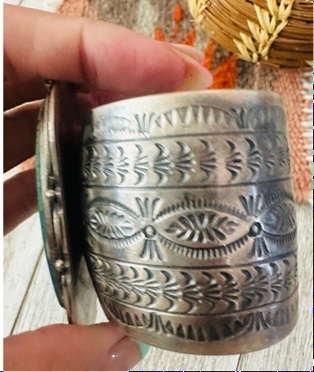
Evening team.. C’est Moi again Nathalie.) Second time on the forum and this is just way too much fun. I’m digging through my bins and bins and bins and finding pieces I can’t seem to want to put down. Hence, here I am. I had a difficult time reading the stamp on this one but I do believe it reads Calvin Delgarito. There is also another stamp on the cuff that I’m unable to make out. Would love to see what your thoughts are on this one, does that name look correct to you? It’s my first experience with this designer. And as always, I appreciate everyone’s insight.


search for Calvin Delgarito products here https://turquoisetradersdirect.com/
to me this bracelet looks frankensteined and not an original design
2 Likes
It’s very interesting how there’s a different hallmark on the band.
The stone is indeed purple spiny oyster.

not listed in the 5th edition
found this on faceflop
https://www.facebook.com/buckinflamingo/videos/boyd-ashley/937461227151025/

which lead me to this mess

source: https://buckinflamingo.com/collections/boyd-j-ashley?page=4
wow, just wow

source: https://buckinflamingo.com/products/lot-111-2-9

but then I go further down the rabbit hole & find this beauty

like night and day craftsmanship and notice the hallmark.
1 Like
I know and to Steve’s point I too thought, hmm mm 
And now Mr. Steve is way down into the rabbit hole bunkers. This one is very peculiar for sure…
2 Likes
Woahhhhhh, you’re wayyyyyy down into the hole. But that ring on the last photo. So good!!! What a peculiar piece. But I think you’re right.. A “frankenstein!” but is combined artists which is verrrry interesting. I’m so, even more intrigued. I wish jewelry could speak.
that’s a cuff bracelet
Welll… I suppose I could write to him directly to see if he knows anything about this piece.
To me this piece totally looks like someone took the Calvin Delgarito piece and soldered it on to the other part. So I would think whoever made the wrist portion would have a hard time recognizing the whole piece.
What I find odd about this is that I cannot find a Calvin Delgarito in Hougart’s 5th Edition (the hallmark book that is considered highly reputable) or on the Amerindian hallmark site. It doesn’t mean he doesn’t exist, but usually a well known artist can be found at least in one of these. Granted, neither of these are 100%, especially the Amerindian site, but to not be able to find it in either is odd. I also couldn’t find the cursive Ashley hallmark in either of those places.
When I used to search icon up above to see if we have had any previous discussions on either of these pieces Boyd Ashley did not come up, and Calvin Delgarito came up with no conclusive information about him.
3 Likes
Same… I’ve come to road block after road block. I’ve officially dubbed the piece Peculiar Purple Mishmash.. I do however find it very beautiful nonetheless. Thank you for all the time you’ve spent looking. It’s been a rather interesting road less traveled experience. Though a very curious one.
You are welcome; I wasn’t quite tired yet so doing a wee bit of research was good, and then I learn also. Some things always remain a puzzle. And that spiny oyster is very pretty. I have orange spiny in some pieces but no purple, maybe someday.
Now I really have to try to get some sleep 
Looks like a cast setting, on a separately made shank, with a template cut cabochon. Items like this one are typically created in quantities of 10 - 20 or so from assemblies of pre-made and pre-cast components pulled from bins of separate, 1. Settings, 2. Pefab or pre cast bracelet shanks 3. Cabochons pre-cut for a paticular setting size. This is usually done in a production environment either in house or as a piece work order where a craftsperson is given the components and a fixed price for completing each item.
The signature on the setting and shank on the original masters may or may not be genuine, however the setting is cast down in quantity from the original master with every detail including the signature nearly perfectly preserved.
The assembly and finishing work could have been done by anyone, nearly anywhere in the world. Once an item is created from a cast down, or a combination of cast down and prefab shank, it is not attributable to any particular individual or tribe, or if an import country of origin sticker has been removed, to any particular country of origin.
ETA: From the photos it looks like your cross was also cast down, rather than an original sand casting. Bezel and twist wire was added during an assembly process as was the squashed silver shot used to create the ‘nuggety’ effect on the recessed surfaces. The hallmark was likely present in the original sand cast master from which a rubber or silicon mold was made. There are likely a number of others in circulation from the same mold with similar or different embellisments.
Once again as a cast down, not truly attributable to a particular artist or silversmith, unless they themselves did the casting and all of the embellishments. This is why provenance is so critically important. Without it, regardless of what hallmark was cast into the lost wax cast down copy, there’s no way of knowing who actually did the casting, embellishment, and finishing work.
YMMV.
11 Likes
@mmrogers Your technical explanations are always fascinating. Can you help me understand the phrase “cast down”? I know what cast is, just not this expression. Thanks.
7 Likes
Sure, @chicfarmer, and thank you.
“Cast down” describes a technique where the original piece, in this case a hand made setting, is used to create a rubber or silicone mold, exact wax copies of the original setting are made by injecting wax into the silicone or rubber mold, the wax duplicate of the molded piece is then allowed to cool sufficiently to solidify to the point where the duplicate can be pulled from the mold and set aside to fully cool. This is usually a very quick process and occurs in a matter of seconds of injection, so many wax copies can be pulled from a mold in a relatively short period of time.
Once enough wax copies have been made, the ‘waxes’ (individual wax copies) are then attached to a more or less long candle shaped wax cylinder to form a ‘tree’ of identical ‘waxes’.
The ‘tree’ is then placed within a surrounding steel cylinder, and a plaster of paris like ‘investment’ is poured into the cylinder, completely submerging and surrounding the wax tree of identical copies.
The cylinder containing the wax tree and freshly poured investment is then placed in a vacuum where any trapped gases and bubbles are sucked out so that the investment surrounding the wax tree is perfectly smooth and uniform with no bubbles or voids (which show up as imperfections in the finished castings).
From there, the cylinders are set aside for the investment to fully harden, at which time the cylinder is placed in a kiln to completely vaporize and burn out the wax tree, leaving a perfect negative copy of the entire tree full of waxes in the hollow areas of the investment.
The cylinder if properly heated is now at casting temp, matching the temperature of molten silver, gold, or whatever other metal is being cast poured, or injected into the investment to create perfect metal copies of the hand made original with every tiny detail perfectly preserved.
While it sounds like and is a lot of work, when making many pieces of the same design, in terms of the time necessary to create each piece, this process is entire orders of magnitude faster and more temporally efficient than fabricating each piece individually by hand, cutting labor costs by as much as 90% or more per piece produced.
A “cast down” is an industry term for items which are exact cast copies of original items originally hand made, or sand cast by hand. These copies are often mistaken for, or often deliberately sold as “handmade” (items fabricated, or individually cast in sand or lost wax completely by hand).
Really good “cast downs” often require a truly expert eye, or even microscopic examination of the metal to discern how the piece was actually made. It’s not at all uncommon for really high quality cast downs to be sold as original works by unsuspecting and reputable dealers who typically are not themselves professional silversmiths, and may rely heavily upon representations made by others of similar stature and reputation.
12 Likes
Incredible learning experiences happening here. CANNOT THANK YOU ENOUGH.. So much appreciation for all silversmithing work. Would have loved to have learned the art.
4 Likes
@mmrogers Wow that’s a ton of useful info. Thank you for taking the time!
6 Likes
My pleasure, @chicfarmer. It’s a real privilege to be able to share a bit if my own experience with my friends here on the forum, and I truly enjoy learning through other’s unique perspectives as well.
8 Likes