That is a wonderful example. The way the whirling log is defined by the four directions and the arrows depicting movement make this an excellent teaching piece. Love that this one is so detailed with the things that wouldn’t be used in a swastika. It’s a great bolo!
2 Likes
@markyboy57 what a fabulous representation of the symbol. I feel these discussions are so important to assure the symbol is not taken wrongly. However I understand how one could be hesitant about wearing it, not wanting to upset others who still consider it as a symbol of hate and nazi domination. So glad you’re son was educated to the true meaning of this historic symbol of harmony and good will.
[/quote]
2 Likes
I’m curious as to how the bolo was made - specifically the whirling log with its raised arrows and raised four directions symbol? The detail, being so small, is amazing.
1 Like
I also wouldn’t want my intentions mistaken by wearing it. People don’t always have the chance to ask you what it means. They just assume.
3 Likes
I think that the center section is cast. If you zoom in you can see some thin casting flaws. I believe that that outside markings are stamped. It is not a very large piece, around the the size of a half dollar.
2 Likes
You know, thinking about it, maybe pressed into a die. I say that because the flaws look like die cracks.
2 Likes
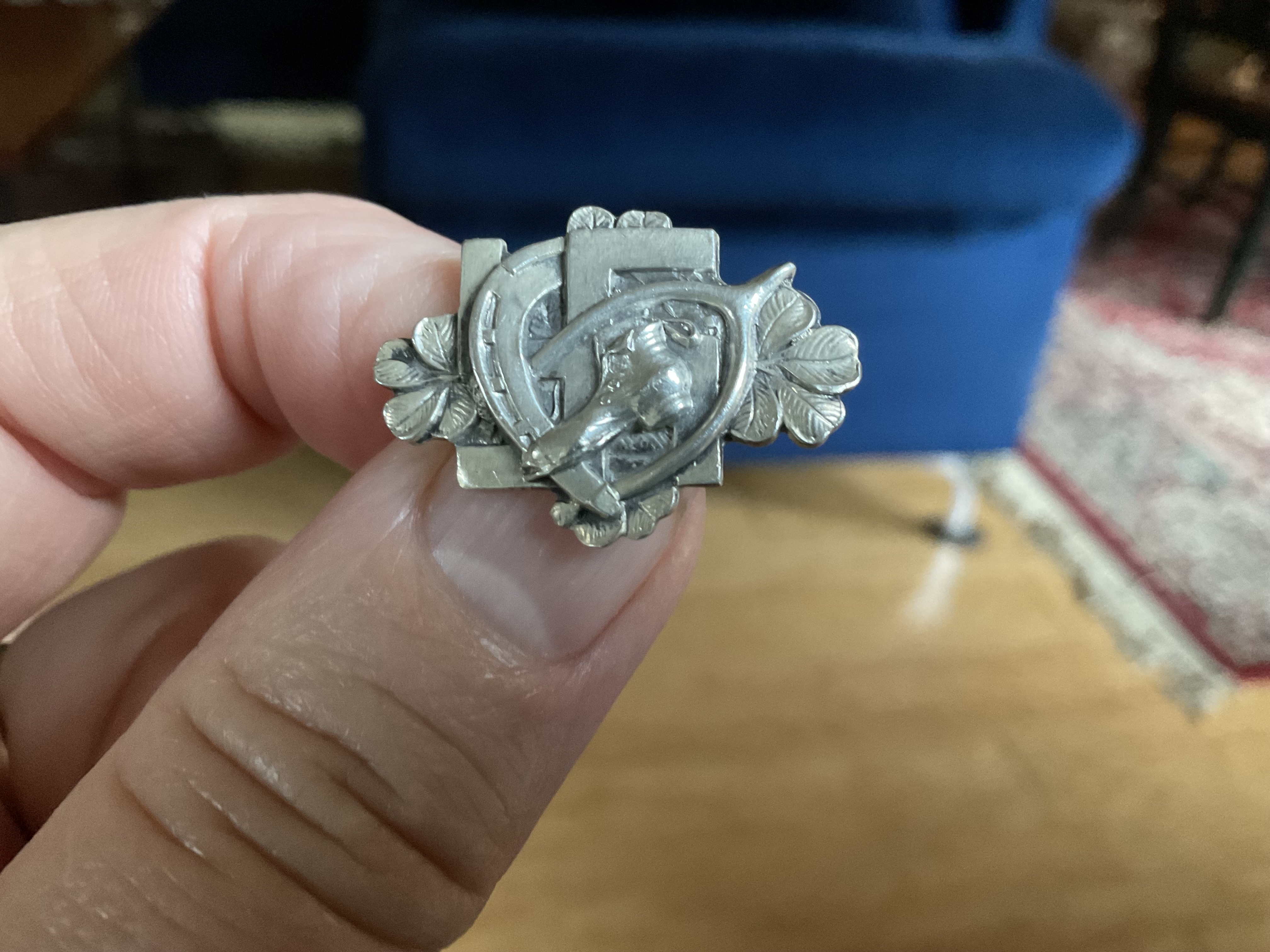
Interesting—it’s an amalgamation of luck symbols: horse shoe, wishbone, swastica, four leaf clover. I can’t tell quite what the one front and center is.
1 Like
It seems to be a boot or shoe!
1 Like
Including this as a generally understood luck image, the pin (is that what it is?) likely predates WW II, I expect. And, probably obviously, this wouldn’t be a NA piece.
1 Like
I’m new to this thread, so my apologies if I am repeating anything.
I’m somewhat familiar with the Asian use of the swastika as an auspicious symbol in the context of Tibetan and Japanese Buddhism, where it dates back many hundreds of years if not longer. You don’t see it often now in Tibetan Buddhist circles because of its modern negative association with Nazism. In Japan the manji is still used as shorthand for “Buddhist”, and in particular on maps you’ll see it used to designate a Buddhist temple. Naturally, foreign visitors who are unfamiliar with its Japanese meaning are often deeply shocked to see it on maps. There have been efforts to find a new symbol, at least on maps designed for foreign use, but this has received pushback by some Japanese. The last time I was there (2017), it was still being used in that context.
The thing is that nobody is really wrong here. It is an ancient and respected Eastern symbol of auspiciousness AND it is also the symbol of a murderous racist ideology. As I was reading about this, I kept remembering an incident from when I was in art class in high school. A student pointed out to another classmate that the wooden pendant she was wearing, which had a complex design similar to the Japanese sayagata, had swastikas embedded in it. Her response was to tear it off her neck in revulsion and horror. Even though it seemed unlikely the artisan had meant anything by it, my friend just could not wear it anymore once she’d seen the swastikas. Some of her family had been killed in the Holocaust. That association was too overwhelming, too painful, for her to see the design’s presence in her pendant as merely “interesting” or academic.
My own feeling is that if I ever come to own an ambiguous object like a whirling-log design–something that’s likely to cause distress in at least some people–I’ll just keep it for home use. Remembering that girl in high school, I wouldn’t feel comfortable doing otherwise.
4 Likes
Thank you for your well thought out post. I have a dear Jewish friend who prob would understand the ancient meaning of the symbol (we have never discussed it), but I imagine she wouldn’t be able to see it without feeling pain, especially now. Her father was an orphan due to the Holocaust.
2 Likes
I would never feel comfortable wearing this either…it was just a good price. I just thought it was interesting how the swatstika had different meanings not only to Native American people but to Americans and Europeans. Now I learned that it has different meanings to Japanese and Buddhists. Thank you for your post.
3 Likes
I guess I’ve reached a point in life where I don’t care what others think and refuse to allow the actions of one man and society’s damning of a historic symbol to dictate my actions ( and we had a relative in the Budapest concentration camp).
It’s unfortunate that we in America have taken a page from Vladimir Lenin. To paraphrase: “tell a lie long enough and it becomes indistinguishable from the truth”. So most choose to live in ignorance, stupidity, and fear.
I would have no problem with NA related symbols.
3 Likes
There is no lie involved in the historical use of this image. It’s true, as is its prior history. All those meanings are real, which is something that when people get uncomfortable they simply deny or try to imagine one meaning only. But the amount of hurt associated with the Nazi image is still reckoned with daily, in the US and globally.
It’s a bit like proposing, I don’t care if people get hurt by ethnic/racist slur words, I’m fine with it. (An odd position to stake out on a Native American-focused forum.) The kind of person who expresses feeling immune to that is probably free of a history of being punished, even hunted, in society. Others are, others have been, and they care.
4 Likes
I agree @chicfarmer . But to me it seems sad to keep placing one evil historic segment on a pedestal rather than try to restore the historic good in something.
1 Like
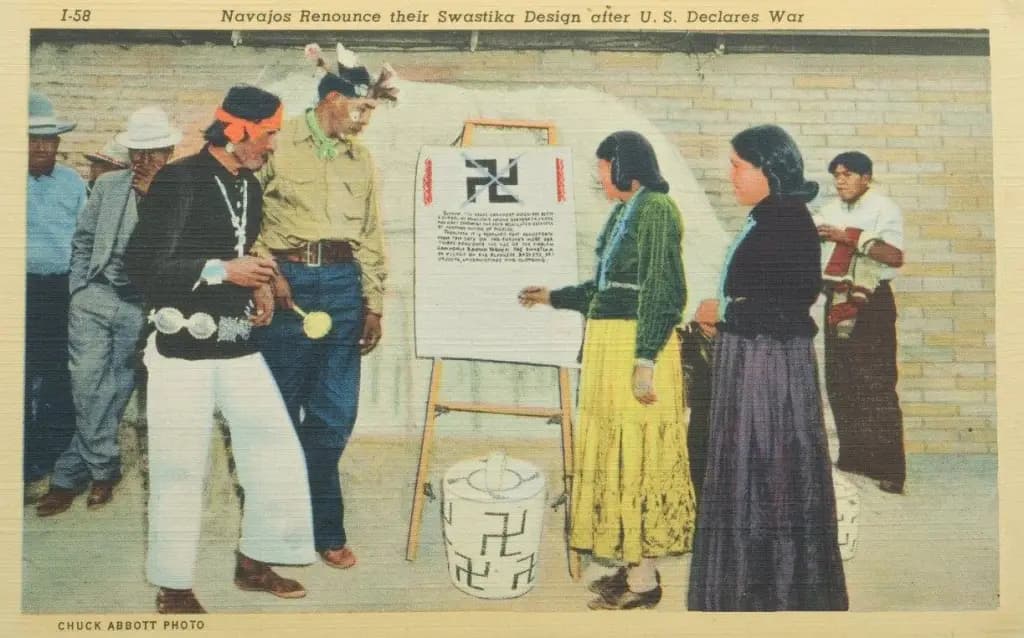
Postcard showing Indians from various southwest tribes signing a declaration that they would not use the swastika symbol on their artwork after February 28, 1940.
Courtesy of:
5 Likes
I’ve been trying to come up a minor comparison. The best thing I can come up with is the Christian ichthus (fish) symbol. Sometimes I see that symbol with feet on it to symbolize darwinism. I hope I’m not offending anyone here, I’ve possibly had friends that have had that symbol on their cars, but when I see the fish with the feet on it I get mildly irritated. And I think, can’t you pick something else? But I’m not angry at them, and I’m not afraid of them. However… If someone’s coming at me with a swastika on them (unless I can CLEARLY see it’s Native American jewelry), I’m probably going to turn and walk the other way. Probably a bit afraid of them even.
I guess what I was trying to say with the example, is that a lot of symbols have been been incorrectly used, but this one has been so corrupted by hate and evil, that I’m afraid, at this point in time anyway, it may be beyond redemption to most people. Sad though that may be, it is what it is.
And I disagree that it was the fault of only one man that the primary association with this symbol today is hate. It was embraced by many, many others (and Germany was not alone in this); he could not have done this by himself.
2 Likes
Funny, my first thought when I saw this pin was the Nazi association. Possibly a Nazi calvary pin (horseshoe, boot and spur); now with the 4-leaf clover I’m uncertain. Don’t know what good luck can be associated with the spur (ha). Regardless, interesting…