


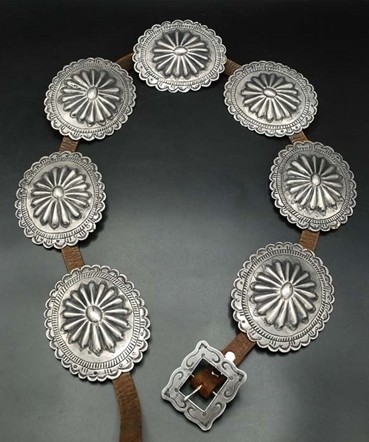
Hello. I am brand new here. Please forgive me if I don’t do this in the right way. I have a belt of my mother’s that I feel like she’s had since the 70s or 80s. And that’s about all I know about it. I would love to know literally anything. I’m very interested in heritage and in craftsmanship. After I learn about these, I may not be willing to part with it,but I’d like to know more about estimated value and where I might be able to put it up for sale. Gratefully and curiously yours, KAY.
4 Likes
Hello and welcome to the forum, @Kenda. Your mother’s belt is a beauty.
It is generally agreed upon that there are three “phases” of concho belts.
- First Phase belts were crafted shortly after the Navajo’s return from Bosque Redondo in 1868. Roughly 1870 ~ 1920, depending on who you’re asking. These belts are identified by the concho’s diamond shape cutouts that the leather is laced through, and their small, harness type buckles. True First Phase belts are comprised of both round and oval conchos, with the round being thought of as being made earlier. Here is a fine example.
Navajo, ca. 1870

- Second Phase belts, crafted from the 1880’s through the early 1900’s, saw the introduction and implementation of soldering (most generally) copper straps on the back of the closed center conchos to secure them to the leather, as well as repoussé design elements, and larger, more ornate buckles. These belts are much more elaborate in their embellishment and overall execution than First Phase belts.
Navajo, ca. 1905
- Third Phase belts are identified by the ‘butterfly” spacers that separate the conchos, as well as the introduction of turquoise. These were crafted from the early 1900’s through the 30’s and showcase the refinement of the form.
Navajo, ca. 1930’s

Please know that nothing I’ve mentioned above is by any means set in stone. There are many museum collected examples with provenance that cross over the prescribed timelines, and there are countless other considerations, but, with any luck, perhaps some of this will provide you with a rough idea.
Your mother’s belt is what would be classified as a First Phase revival; meaning it is crafted in the style of the original First Phase belts, but at a much later date. The revival of the older belts has been commonly practiced from the Second Phase to current day. It looks like it could have been crafted in the 60’s or 70’s, when Native American jewelry was really starting to boom, and that is shored up by the decades you believe she acquired it within.
Here is a thread containing a somewhat similar belt as well as some great info.
If you’re really wanting to learn, check out @TAH’s Belt Buckles & Concho Belts thread.
Concerning a valuation, personally, I’m not comfortable providing one. There exist numerous examples of similar belts that have sold that could provide you some insight. As far as selling it, there’s always eBay, with its steep fees, or you could consider consigning it to a gallery in the Southwest.
Thank you for sharing!
13 Likes
Hi and welcome to the forum. Your mother’s belt is lovely and as I’m reading through I see that @Ravenscry has given you excellent advice. You will find a lot of information in those.
6 Likes
Thank you very much Ravenscry. It is interesting to learn about the different phases. I particularly enjoyed seeing the round conchos. That is a beautiful design and I can only imagine how the oval came into favor over the years. I will look into the images and link you provided. I appreciate your response and just in general so appreciate the chance to communicate with someone. Be well.
3 Likes
Yes indeed. Thank you for chiming in.
3 Likes
You’re more than welcome! I’m glad to offer a little help. I think you’ll enjoy the thread I linked. There are many knowledgeable and experienced members here, but @TAH is very well versed concerning belt buckles, concho belts, and earlier Navajo silver: that thread of his is full of great stuff. 
2 Likes
I just googled first phase revival concho belts and it was delightful to be able to look at belts in a new way based on what you shared. I saw many that were listed for sale in the high hundreds and often thousands. I respectfully understand your desire not to estimate a value. I just want to do a reality check. If you could steer me at all I’d be grateful. The high cost ones seem to refer to a sterling marking and also to a maker’s mark. I imagine that the one I have is copper underneath. I don’t want to try to clean the conchos and take off the patina life has given them. And I don’t see any kind of stamp at all on the underneath of the buckle. I don’t know what to call the belt in terms of the metal used. I just love the belt and while I don’t wear large belts I was thinking that I might be able to incorporate the conchos into a garment somehow. That said I do not want to do that and destroy the financial value of the belt if it is for some reason sellable for a handsome price. I love the idea that getting a handsome price would be a way to do something nice for my mother.
3 Likes
Considering there are no copper straps soldered on the back of the conchos, the verdigris that is present where the belt strap is laced through the cutouts could be an indicator of either high copper content silver or a silver plated copper substrate. There are methods to determine silver content, and some jewelers offer this service.
When you find it convenient, would you be willing to share a clear, close up photo of the back of the buckle?
2 Likes
It’s a lovely belt, and thank you for posting @Kenda . Please take closeups of several of the conchas, and photos of the back of the buckle, a close up of the edge of one or more of the conchas, and a good closeup of the back of one of the conchas (with leather backing) as well. At first impression, the work and design stamps look much more recent to me than first phase period. I’d like to get a close look at all of the above.
I’m wondering if this may be an homage piece from a Santa Fe or Taos silversmith like Patrick and Anita Ohlinger, Jenny Sivohnen, or one of the other great northern New Mexico silversmiths working in this classic style.
7 Likes
Ravenscry and Mmrogers, thank you for reaching back out. It is such a joy to learn. I only hope that I am as generous and helpful in my own areas of study with others as you are. I have taken more pictures of the larger conch belt. I will include some of a rectangular and narrow belt that was also my mother’s in a separate post. She did indeed spend some time in Santa Fe in the late 70’s. She was glowing when she got back.


3 Likes
Here are pictures of the rectangular narrow belt. I have really enjoyed it since I was just a teenager.


3 Likes
Thank you, Kenda. These are great photos! That a belt of this quality is unsigned is interesting. The style is certainly Navajo. There’s no question it looks handmade, and that the workmanship and stamps are excellent quality. One of the reasons I asked you for closeups of several of the conchas is that I’d liked to to do an overlay transparency of 3 or more of the conchas, but for this we need shots looking at the conchas straight down. If you can get thee in a tight frame, looking straight down at them, that should be sufficient to determine if We’re looking a individually handmade conchas with the slight natural differences one sees in hand fabrication, or if we are looking at a number of identical conchas cast from one individual handmade original. Even without attribution, this has a direct bearing on provenance and value.
4 Likes
Oh I will get three in a row looking straight down upon them asap. Thank you. I really appreciate your interest and kindness.
4 Likes
Mike,
I know we’ll learn more when Kenda shares more photos, but what do you make of the thickness of the concho she shared in the fourth photo? It looks exceptionally hefty.
4 Likes
We’re probably looking at at least 12 gauge, Aaron. we see from the striations on the sides that that the Buckles were hand sawn. Those cut are very straight. The maker really knew what they were doing. As you know marks like striations are reproduced faithfully in a casting. I’d still like to see a close-up of three of those conchas in the same shot for comparison.
4 Likes


Perfect! I can adjust perspective and angle in Photoshop. Thank you @Kenda!
4 Likes
Ravenscry, Hello. I am wondering if you might have any ideas on the second belt that I posted pictures of. It is so different. So much smaller and it is signed. I appreciate your thoughts on the larger belt and look forward to what my latest pictures might provide mmrogers with. Happy Saturday.
2 Likes
Hey @Kenda. When you have a moment, could you please share a close up, clear photo of the buckle, straight on?
3 Likes
Just adding a little content on the artist of the second belt…

(1913-1997) Leo Coriz was one of the most accomplished. widely respected elders and silversmiths in the history of the Santo Domingo Pueblo. Keeping in mind much of his work was done without the use of electricity or wheels, yet this master created beautiful pieces of jewelry. His work inspired other silversmiths throughout the Pueblo. - Browns Trading Company
4 Likes