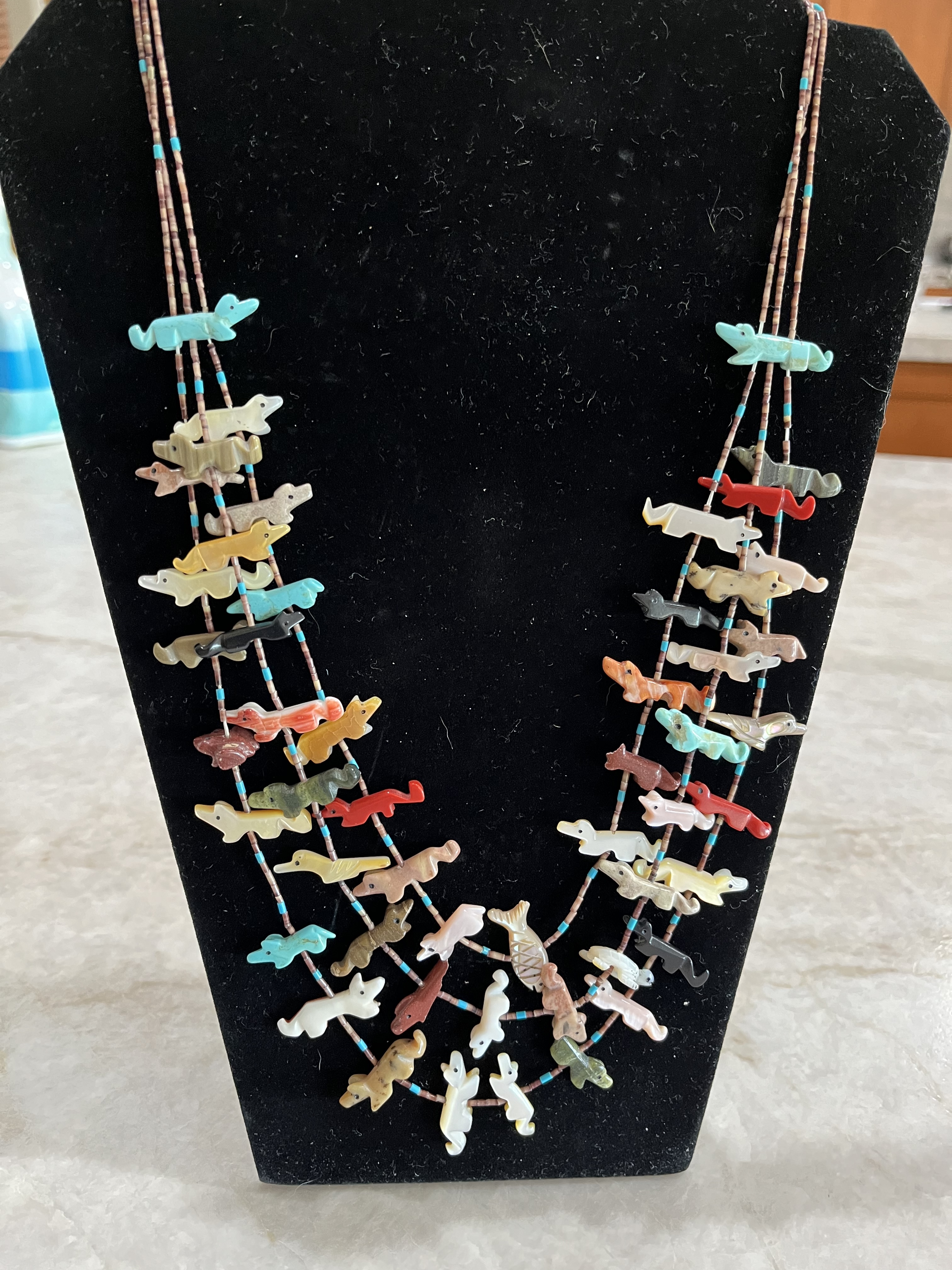
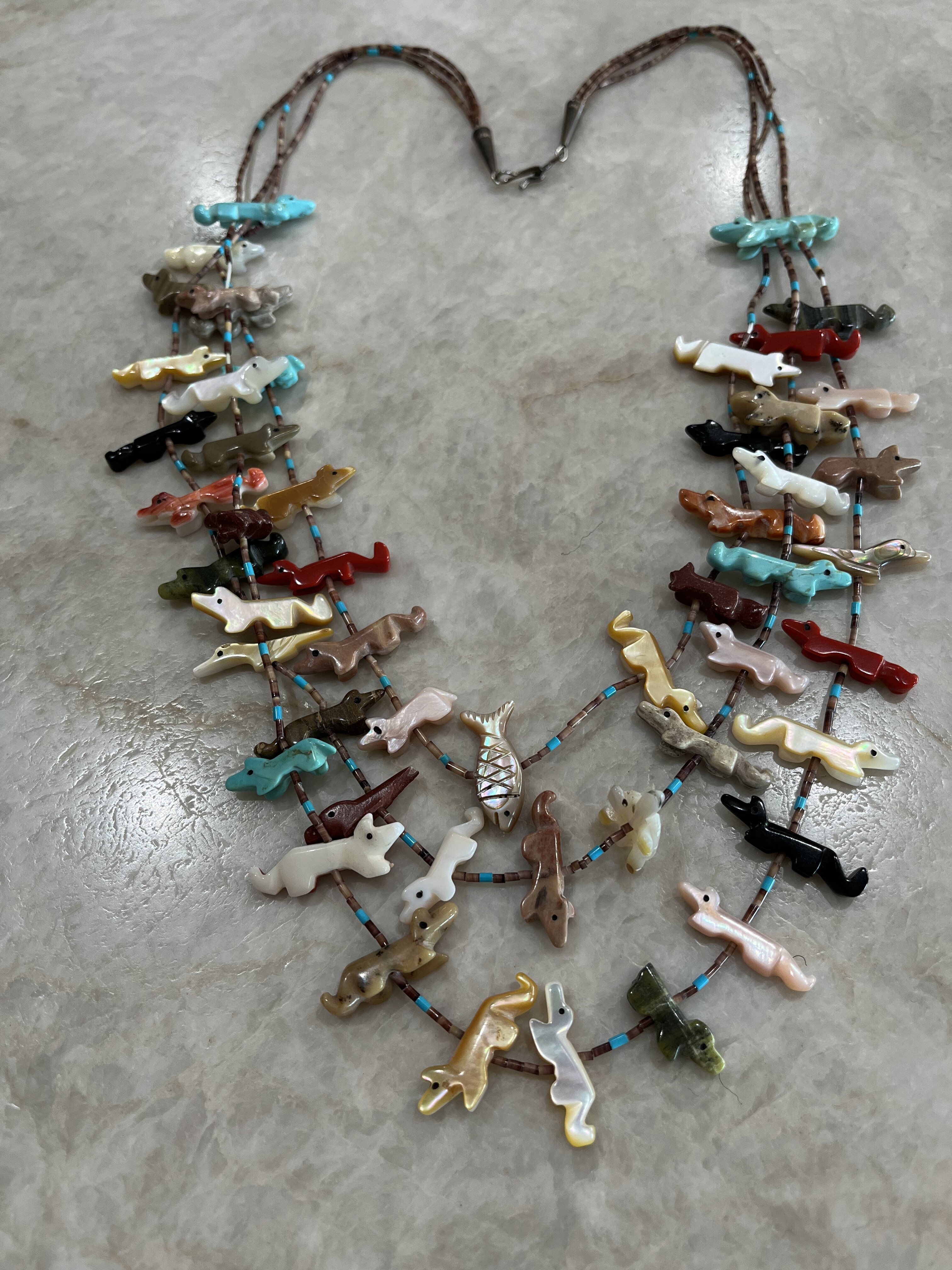
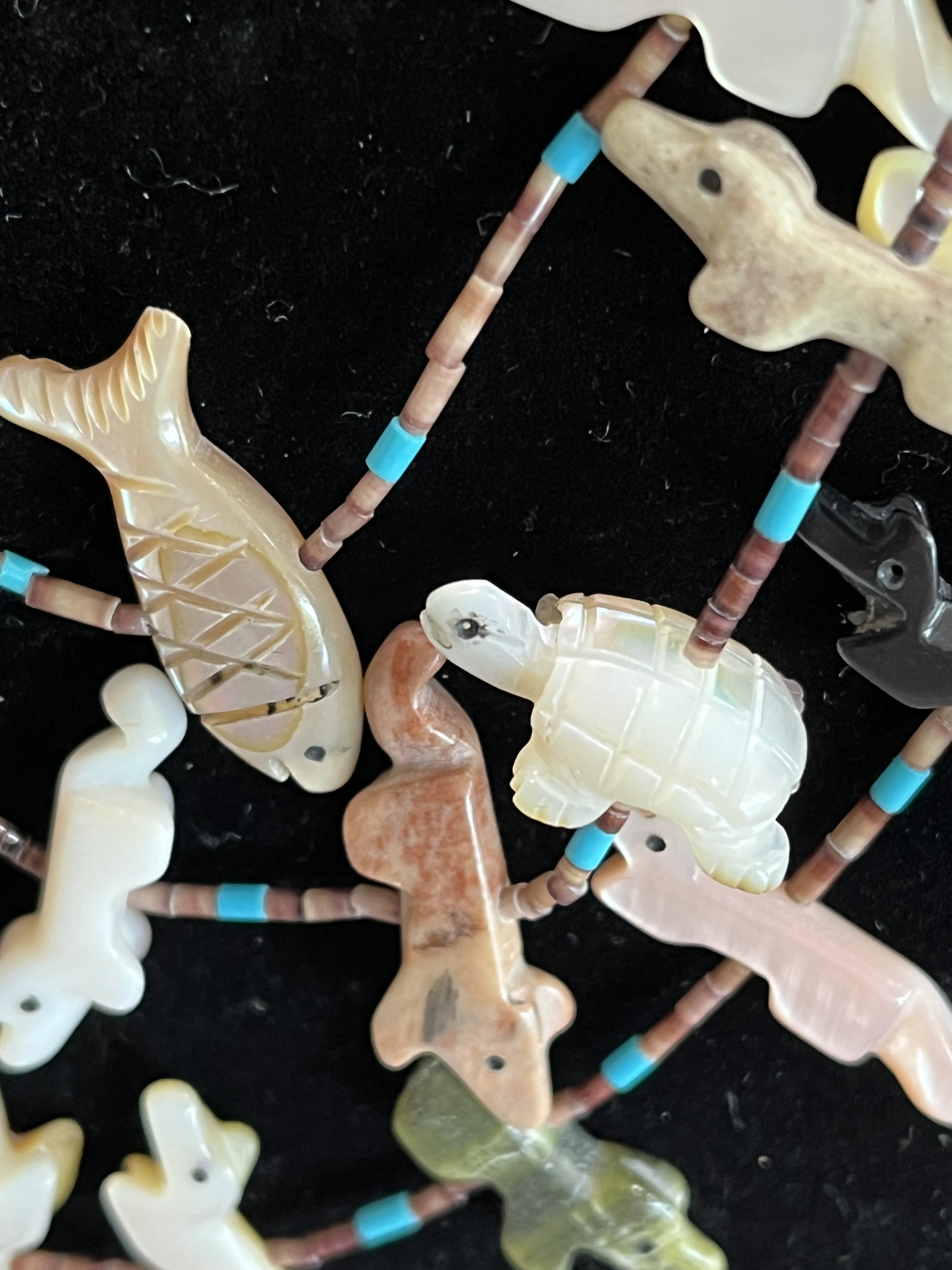
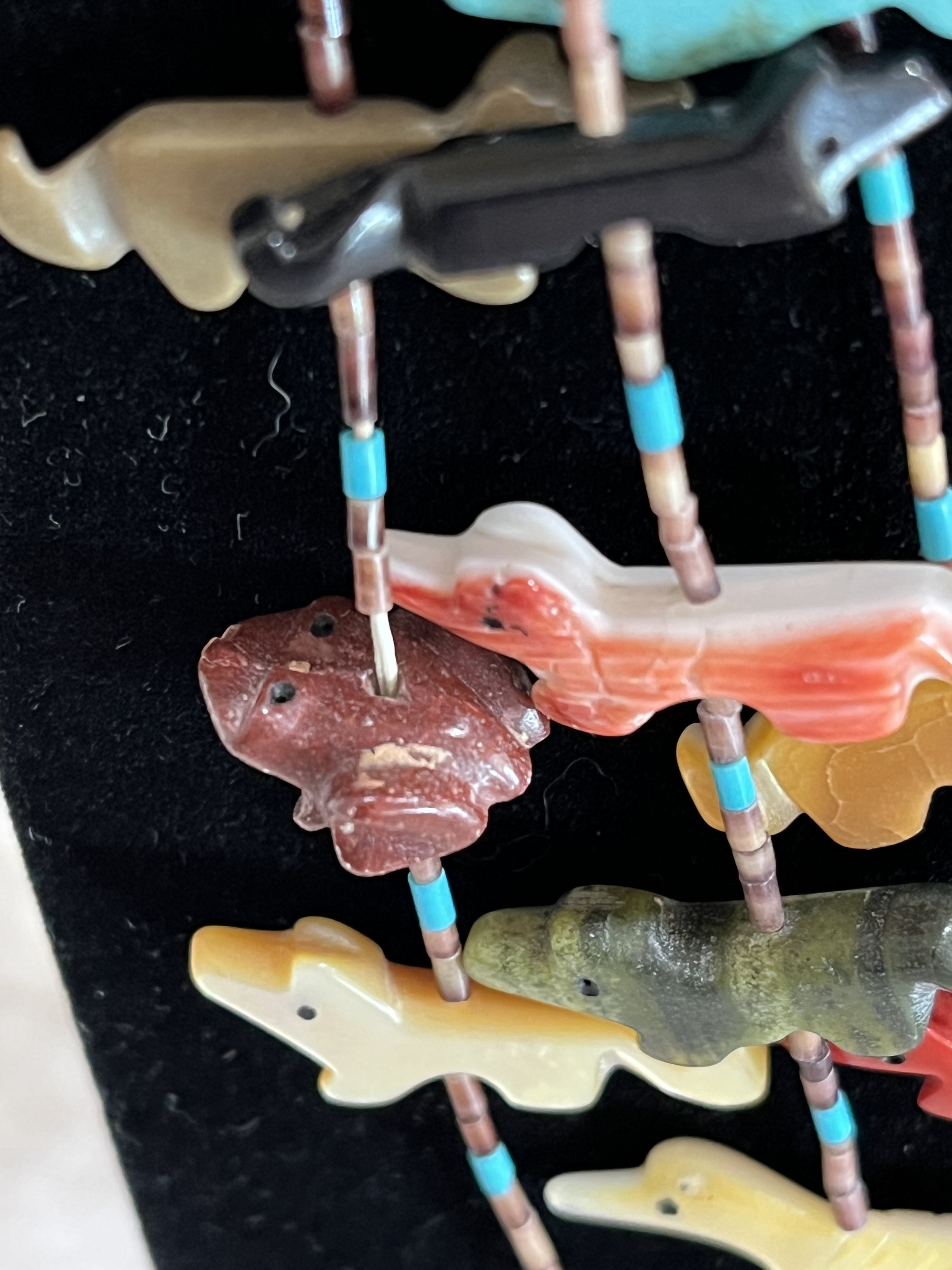
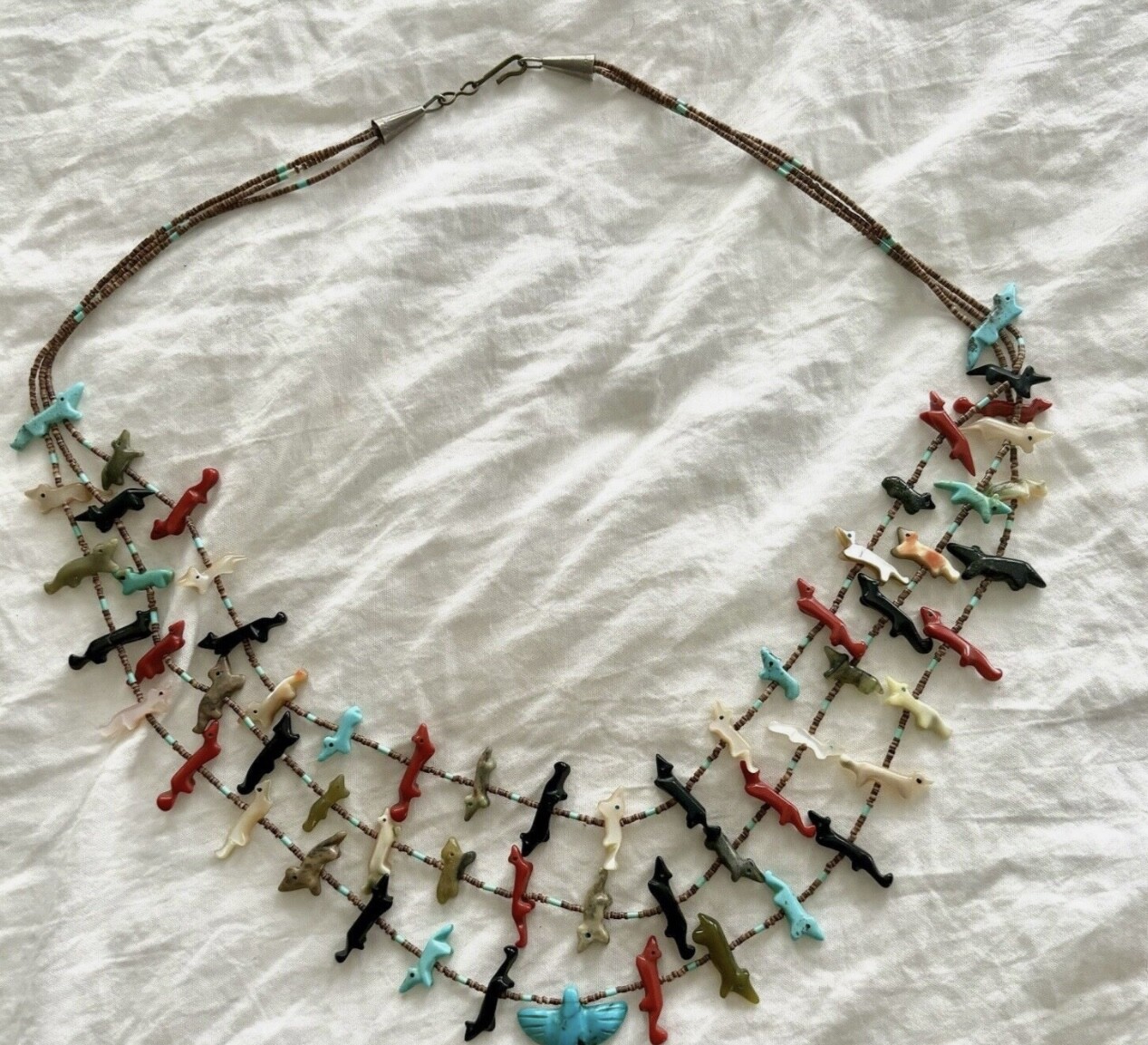
OK, OK, I know its like beating a dead horse (I hate that analogy), but as I was going through a lot of my older jewelry I don’t wear anymore, I came across this delicate fetish necklace. I purchased it early in my collecting, probably in the 70’s. I likely thought it was Zuni at that time, but now I’m thinking Navajo. Most of the fetishes are pretty basic, unlike the better carved ones in my known Zuni necklaces. The heishi strands are very thin and delicate and a few fetishes are quite nicely caved. I’ve read about Zuni vs, Navajo fetish necklaces, but there are exceptions to everything.
Hoping to learn more; Any thoughts?
6 Likes
Looks like a nest of Zuni style wiener dogs. 
6 Likes
I have a similar bracelet, which I will need to post here also. The fetishes seem fairly real, but not all that detailed. In my case, I did buy it at a tourist area but I paid more since I looked for the sellers that were not selling the common tourist stuff. I think things used to cost less back then (I bought mine around 2001 or so) and it’s possible that what you have here is a good quality piece, but maybe not as good as some of the collector pieces; i.e. made by an actual Indian, but not something that is of great value, or using pre-made pieces.
3 Likes
Hi @Bmpdvm That’s a nice fetish necklace. I especially like the many different stones that were used in its creation. Quite the variety. I have a few of these ubiquitous fetish necklaces but haven’t posted them here. From what I’ve read, Zuni fetish necklaces are hand-carved and exhibit good detail work. So, that excludes all my necklaces, lol. Not sure about your necklace being Navajo, either. When I see fish, whales and other odd assortments in fetish necklaces, it gives me pause as to whether it’s Native American made or not. My fetish necklaces are most likely neither Zuni nor Navajo made. Just my 2 cents worth…
4 Likes
Thanks Patina. I know the vast majority of these are not Zuni, and likely not even NA. I should have said “Navajo or other” as it (or the beads) are likely made elsewhere, especially with the turtle and fish. I’m going to sell it along with a lot of other lesser pieces, and want to be accurate with the information. Guess the best way is just to be vague and simplistic in the description and not mention any NA attribution😊.
3 Likes
Just to add a bit of spice (or frustration) to the conversation, I googled Zuni fetish necklaces and found this:
It’s an “Award Winning Tony Luala Authentic w/ Certificate 3-Strand ZUNI FETISH NECKLACE”. It has a ribbon, a certificate and everything! So it must be authentic!!!.
It also has a lot of red flags and looks very similar to mine (sans the fish, turtle and frog!) and is going for $2100.00…
Is Has anyone ever heard of Tony Luala? There are a lot of fetish necklaces on eBay by him. Are the Zuni now churning out non-Zuni styles of fetish necklaces.
With purported documentation, no wonder there is so much confusion.
2 Likes
A minefield…so true. I went through a collecting phase, some of the first NA I collected were fetishes. Fortunately I still have some pretty nice fetishes by good names (now deceased).
Anyway, thanks for weighing in, that last piece claiming to be certified Zuni just proved how much I don’t know. Is Tony Luala be Zuni? And are all the necklaces attributed to him made by him? All depends on if you believe the sellers info. and makes me see red flags!
I feel like I’ve read or heard that name somewhere, but it may have been somebody asking the same question that you did.
1 Like
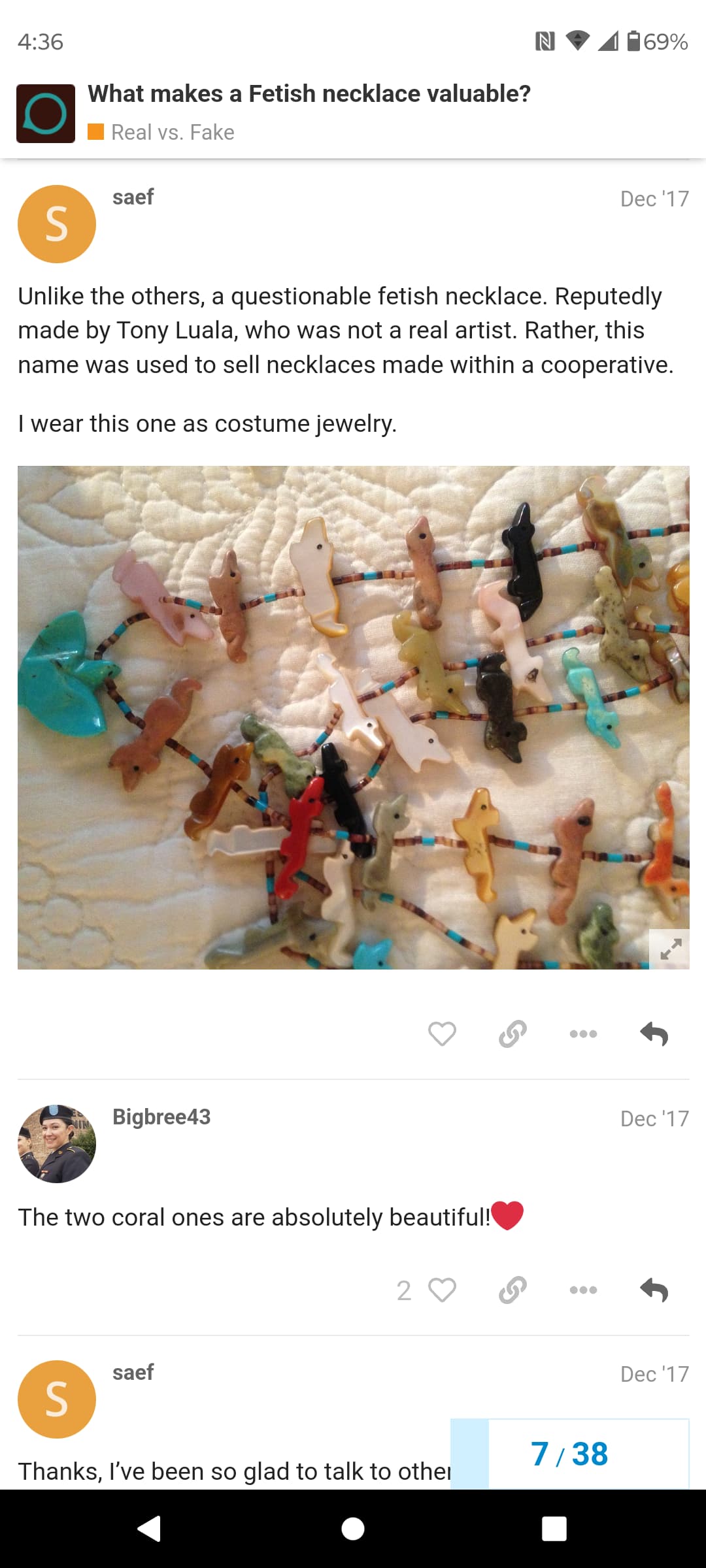
Here’s a thread I just found in here that mentions his name.
What makes a Fetish necklace valuable?
1 Like
I just tried to read through this, and my eyes started to glaze over again…
1 Like
Yep, great memory!!! It totally makes sense but I’d like to know where saef got that info. If I get to Zuni before too long, (and if I remember🥴), I’ll ask Milfred Nahohai about the name. Or the Keshi folks should know. The info in the that thread was in 2017, and Tony Luala is still stated to be Zuni all over eBay…crazy!
1 Like
You could try responding to saef in the thread, but it looks like that person hasn’t been on the forum in a very long time.
Let us know what you find out!
Agree that nontraditional animals, fish and such, are a red flag. We just can’t underestimate the amount of imports that have been in the marketplace for quite a while by now, some very skillfully made, too.
If I were selling it, without firm provenance I might say at most “Southwest style.”
4 Likes
Ha…I was thinking Zuni style, but Southwest might be better!
1 Like
I have to agree with y’all; the world of fetishes is indeed a minefield and I certainly lack the knowledge to identify real ones vs. fakes! I think less detail and stating that it’s Southwest style or simply provenance unknown would be appropriate. FWIW, I think it’s a pretty necklace!
2 Likes
I came a cross this amazing pin pendent this am, and my brain immediately though “Zuni”.

Just wondering what the group thinks.
The stated artist is Shirley Bahe, not a Zuni name. This is what Al Anthony states:
Master silversmith Shirley M. Bahe (Diné of the Navajo Nation ) is celebrated for her exceptional mastery of labor-intensive lapidary techniques. While she brings her Diné heritage to her craft, her work beautifully showcases the specialized needlepoint and cluster styles historically perfected by Zuni Pueblo jewelers.
Another example of how first impressions are sometimes wrong. Looking at it a bit closer there are Navajo characteristics, but the delicate needlepoint and tiny sawtooth bezels screamed Zuni to me.
6 Likes
Late to the thread, but I saw and bought Zuni fetishes like the ones in your original post when I was trading full time in the Pueblo in the early to mid 80’s.
As for style, I’ve always found it interesting that we collectively have a tendency to want to shoehorn creatives into neatly ordered boxes of this tribe or that tribe, or he or she does this or that when human nature tends to work outside of those boundaries.
There really are no hard and fast rules about who does what, and I’ve found Native artists experiment with and work in styles other than those associated with their tribal origin all the time.
9 Likes
I think it’s beautiful, and a stunning piece of craftsmanship. When will you be receiving it? 
Concerning stylistic influences and one culture utilizing traditional practices and techniques mastered by others, @TAH and I recently discussed a belt buckle that is being sold by a reputable dealer as Hopi, but has clear Navajo undertones and sensibilities, as well as elements that don’t appear anything like traditional Hopi work. It’s an interesting piece, for sure.
One thing we discussed was the very real scenario of men and women from different cultures marrying into another. If a Zuni woman, who has mastered her lapidary work, married an accomplished Navajo silversmith, together, they may turn out work that is unlike anything from either culture.
I completely agree with @mmrogers; while there are a lot of considerations and certainly no strict guidelines for identifying work, it’s made even more mind boggling when you consider all of the possibilities. 
7 Likes
Something I noticed about Zuni fetishes vs foreign copies early on was not necessarily the ‘style’, but the tools used to create the fetishes. Knowing what tools are used and the way they’re used should be studied by every serious collector, or dealer working in this area.
Zunis usually have very simple lapidary setups, primarily simple stone saws, grinding wheels, and belt sanders set up on arbors with a water supply to keep the items they’re working on lubricated. Some with a little more sophisticated setups may have a rotary tumber, or flex shaft drill they work with, but generally speaking the tools are very simple, basic, and affordable.
Fetishes are largely carved on the flat surfaces and edges of a stone grinding wheel to shape them, and if not rotary tumbled (another simple tool) in between, finished with buffing compounds on fabric or leather wheel using compounds like white diamond (trade name, not material) and Zam for the final polish. Some of the straight cuts you see are done simply with the edge of a lapidary saw.
The “inlaid” eyes are often just a drill impression dabbed in with a permanent sharpie marker, or enamel.
Foreign fetishes often employ more sophisticated tools like ultrasonics because the point there is fast, fast, efficient production to keep labor costs at an absolute minimum. Even the untrained eye can usually tell something is “off” with the way they look, but without specific knowledge about how the original authentic fetishes are created it’s hard to put ones finger on exactly why they look “off”.
4 Likes

